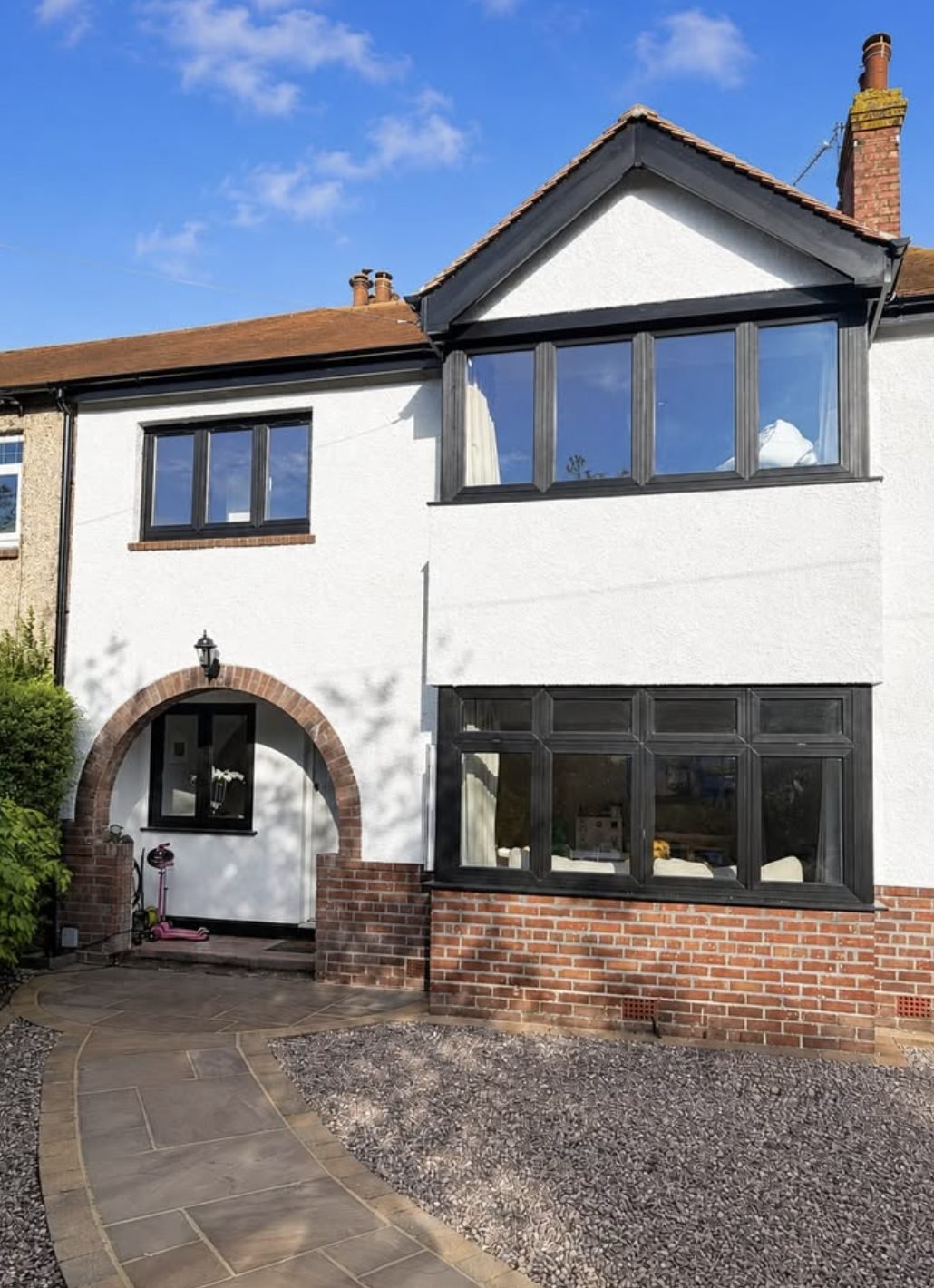
Render repairs and restoration
Something has cracked, come loose or fallen off. The useful work happens before any material is ordered: finding out what shifted, and whether it has settled. Covering a problem that is still active means paying for the same wall twice.
- Cracked render
- Hollow render
- Patch repairs
- After new windows
- Chimney stacks
- Overcoating
Get it looked at
A photograph and a postcode is usually enough to begin.
Straight to us, not to a lead panel. One call back, then a figure in writing.
What the calls are usually about
Listed roughly by how often they come up. The first two are impossible to tell apart from the pavement and want opposite responses.
Directional cracking
Lines with an angle or a run to them. These are following something and need tracing.
Surface crazing
A fine even web across a panel. Alarming to look at, almost always superficial.
Debonded areas
Coat and wall have separated. Nothing re-attaches it; it has to be taken back.
Damage around openings
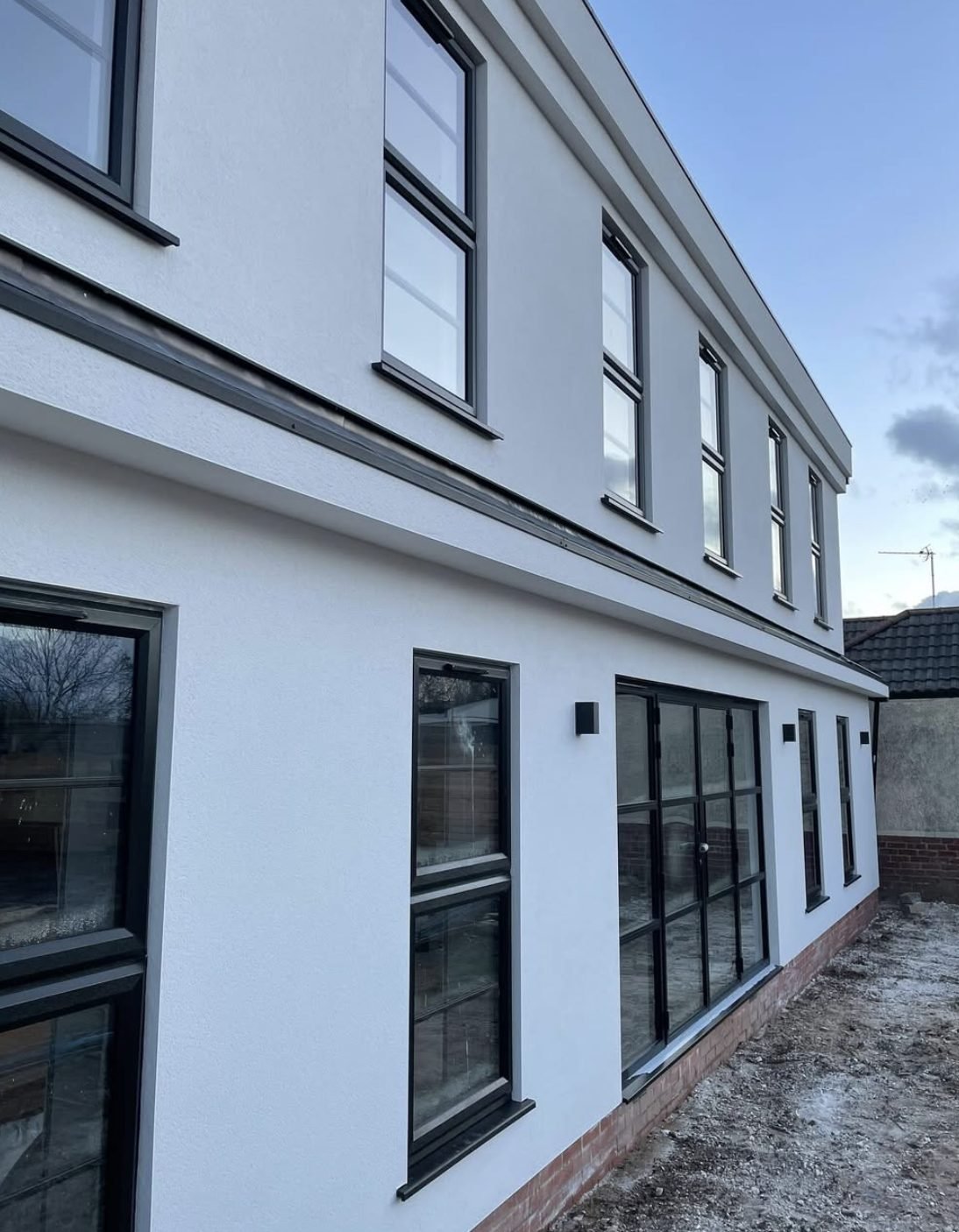
Left behind by window and door installation, where beads and cills were disturbed.
High-level failure
Stacks and apexes, which weather hardest and get inspected least.
Persistent damp staining
Dealt with above the wall first, then on it. In that order or it returns.
Half an hour that changes the whole quotation
There is no way to look at an elevation and know whether the coat is still holding. A wall in perfect visual order can be entirely detached behind the finish, and it stays that way until the morning a piece of it lands in the flowerbed.
So before any figure is written, somebody works across the whole surface by hand and listens for the change in note. Attached material sounds dull and solid; detached material sounds like a drum.
Everything that drums gets chalked up and measured. It means your quotation is built around the wall as it genuinely is, rather than around the version of it visible from the gate.
The parts of the house nobody inspects
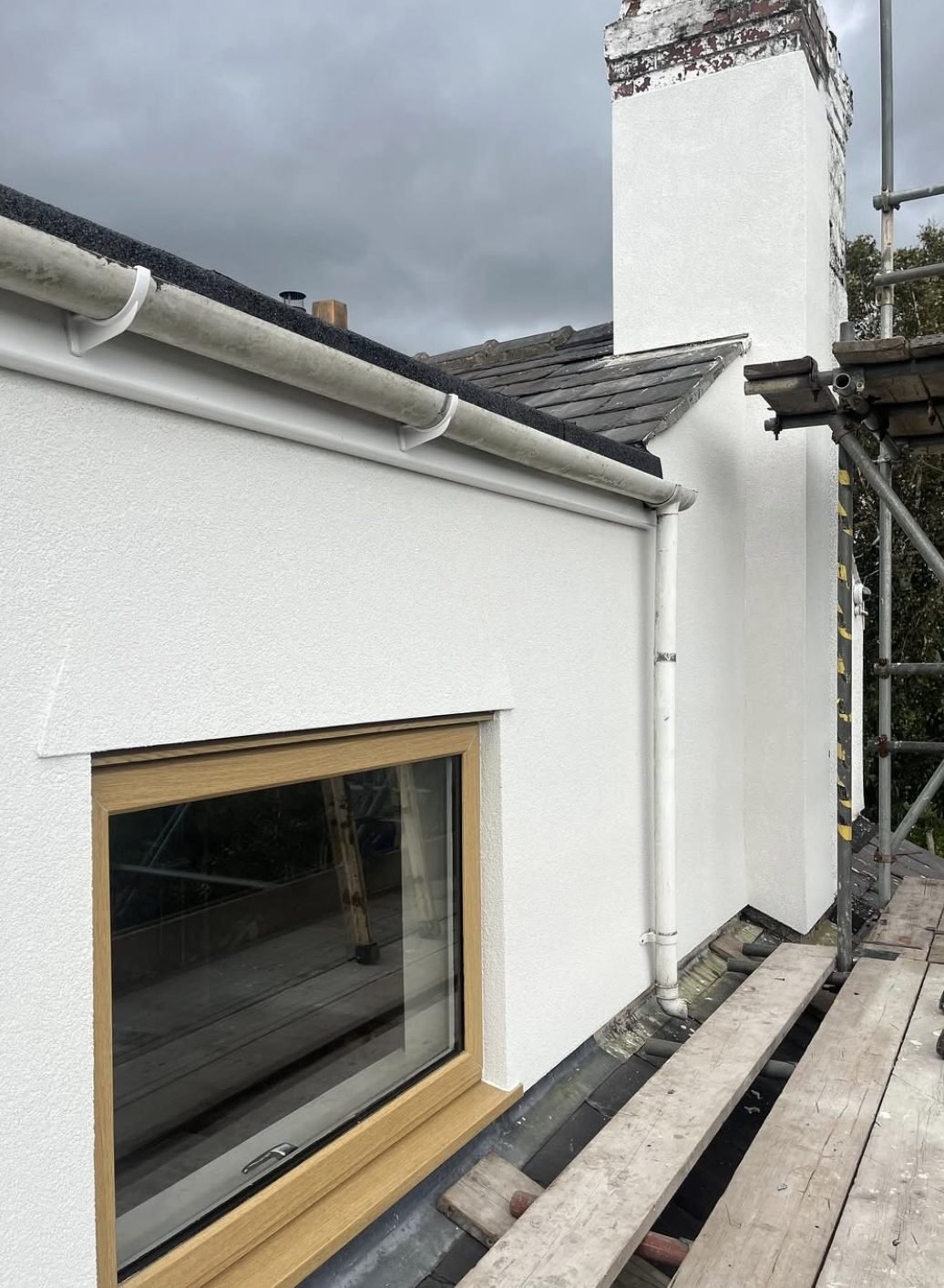
A chimney is exposed on every side with no adjoining structure to shelter it, and the top of a gable is barely better off. Between the two they generate far more failures than their share of the surface area would suggest.
They are also the hardest things to examine without proper access, so they tend to be left until something visible happens. By then the repair is larger than it needed to be.
Worth knowing: if a roofer or a guttering firm already has a platform standing on your property, that is the cheapest week you will ever have to get the high-level render looked at. One phone call while it is there.
Want to know what you are actually dealing with?
Talk it through on the phone or send images over. You will get a plain assessment before money enters the conversation.
Repair questions
How worried should I be about a crack?
Read the shape before you read the size. Fine lines spread evenly across a whole panel are the material having shrunk as it dried, and they rarely mean anything structural.
What deserves attention is a single line with direction to it, especially one leaving the corner of an opening at an angle, or one running dead straight for a metre or more. Those are following something. Send us an image taken face on and we can usually place it.
Our builder says it just needs filling.
It might. Whether it does depends entirely on whether whatever opened the crack has finished moving, and a tube of filler cannot answer that question.
Where the movement has settled, filling is genuinely the right call and we will say so. Where it has not, you get the same crack back within a year, usually reopening a short distance from the repair rather than through it.
How can you tell which parts have failed?
We listen to the wall. Material that is still bonded returns a flat, dull knock. Material that has parted from the masonry rings hollow, because air has got in behind it.
It is not detectable any other way. Photographs will not show it and neither will standing back and squinting. A wall can be immaculate to look at and completely finished underneath.
Will a repair be noticeable?
On a painted elevation it does not have to be, because the entire wall can be recoated once the new work has cured and everything ends up the same age.
On a through-coloured finish that has weathered for a decade, yes, to some degree. New material sits differently against old. We would sooner tell you that at the quoting stage than have you discover it at the end.
The north wall keeps going green however often we clean it.
Growth colonises surfaces that stay damp. An elevation that gets little sun dries slowly at the best of times, and anything dripping onto it from above turns slow drying into permanent wetness.
Treating the wall clears what is on it today. Until the water stops arriving, it comes back. So the gutters, hoppers and overflows get inspected before anybody touches the render.
Our new windows have left a mess around the openings.
That is normal and it is not really a glazier's job to put right. Fitting frames almost always breaks the surrounding coat back, removes beads and disturbs cills.
We rebuild the reveals, set fresh beads to a line, and feather the repair well away from the frame, so the join is not sitting in the exact spot people look at.
Is it worth repairing a rendered chimney?
Only once you know what the render is covering. A structurally sound stack in a tired coat is a straightforward job with a long life in it afterwards.
A stack whose mortar beds have gone soft is a different proposition. Rendering over perished bedding hides the problem for a winter or two and then costs more to put right than it would have done. We will tell you which one you have.
When does it stop being worth patching?
Our rough marker is a third of the elevation. Once you are cutting out more than that, the edge work, the cutting and the making good start to approach the cost of simply recoating the whole wall.
And you are left with something that reads as repaired rather than finished. We will point that out when you reach it, even when the bigger job is the one we would rather not talk you out of.
Show us what you are looking at
A couple of images usually settle it. One close in on the damage itself, near enough that the edges are sharp, and one stepped back far enough to show where on the building it sits.